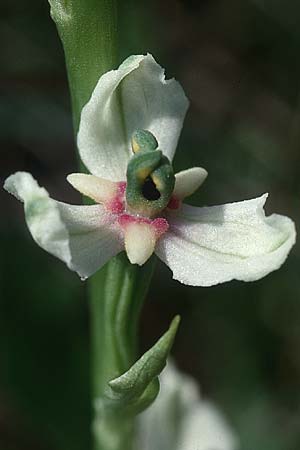
 Platanthera bifolia Pelorie, A Lechtal 15.7.87
Glossar:
Pelorie, pelorisch
Ungewöhnliche Regelmäßigkeit oder Symmetrie in der Form einer Blüte, die normalerweise unregelmäßig ist.Die Blüten der Orchideen bestehen aus 6 Blütenblättern: 3 Sepalen, 2 Petalen und eine Lippe. Bei einer pelorischen Orchideenblüte, die auf einen genetischen Defekt zurückzuführen ist, sind die Lippe und die Petalen annähernd gleichartig: entweder ist dann die Lippe als Petal oder die beiden Petalen lippenförmig ausgebildet. Aus der zweiseitigen Symmetrie der Orchideenblüte, die nur eine Symmetrieachse hat, wird also eine strahlige Blüte, die im Fall der Orchideenpelorien dann 6 Symmetrieachsen besitzt.
Man nimmt an, dass sich die heutigen Familien der Orchideen und der Liliengewächse aus einem gemeinsamen Vorfahren entwickelt haben, der wie die heutigen Liliengewächse 2 Kreise zu je 3 gleichen Blütenblättern besaß. Die abgebildeten Pelorien können dann als genetischer Rückfall in die Entwicklungsgeschichte verstanden werden, was auch als Atavismus bezeichnet wird.
Die attraktivere Form einer Pelorie, bei der die Petalen lippenförmig ausgebildet sind, habe ich in der Natur leider noch nicht angetroffen. Das Bildbeispiel unten zeigt eine pelorische Phalaenopsis mit lippenförmigen Petalen. Diese Pelorien sind Mutationen, die man durch Zucht nicht erreichen kann (höchstens durch Genmanipulation, falls schon bekannt ist, welches Gen man manipulieren müsste). Ich vermute, daß diese Phalaenopsis im Urwald gefunden, und dann durch Stecklinge (nicht durch Samen) weitervermehrt wurde, wie es bei vielen Orchideen-Hybriden in den Blumengeschäften, von denen die Samen oft sowieso nicht fertil sind, auch gemacht wird.
 Ophrys holoserica Pelorie, D Saarland 24.5.99
Glossary:
Peloria, peloric
Unusual regularity or symmetry in the form of a bloom, which is usually irregular.
The blooms of orchids consist of 6 petals: 3 sepals, 2 petals (in narrow sense) and a labellum. At a peloric orchid bloom, which is caused by a genetic defect, the labellum and the petals have nearly the same form: either the labellum has the form of a petal or the two petals are labellum-shaped. The two-sided symmetry of the orchid bloom, which has only one symmetry axis, mutates to a radial bloom, which in case of peloric orchids has 6 symmetry axes.
It is assumed that the current families of the orchids and the lilies have developed from a common predesessor, whose blooms consisted of 2 circles of each 3 equal petals as those of the lilies. So the shown peloria can be understood as genetic relapse into the history of their development, which is also called atavism.
Unfortunately I didn't yet manage to find the more attractive form of a peloria, which has labellum-shaped petals, in the nature. The example below shows a peloric Phalaenopsis with labellum-shaped petals. These peloria are mutations, which can't be reached by breeding (but probably by gene manipulations, if the gene to be manipulated is already known). I assume that this Phalaenopsis has been found in the jungle, and has been multiplied by slips (not by seed), as it is done with many orchid hybrids in the flower shops, too, of which the seed is often not fertile.
 Phalaenopsis Pelorie, cultiv. 22.4.90
Rev.: 22-Jan-2014