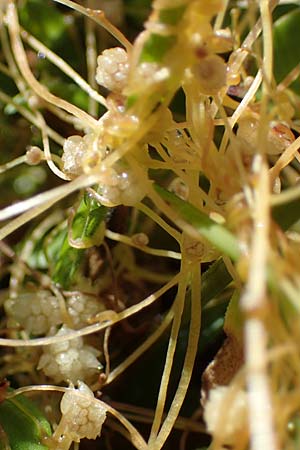
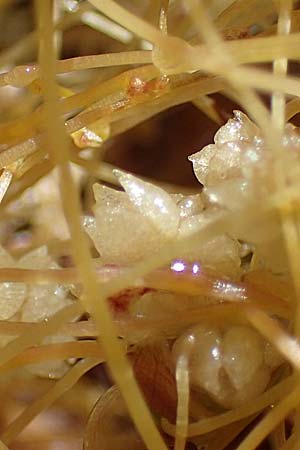
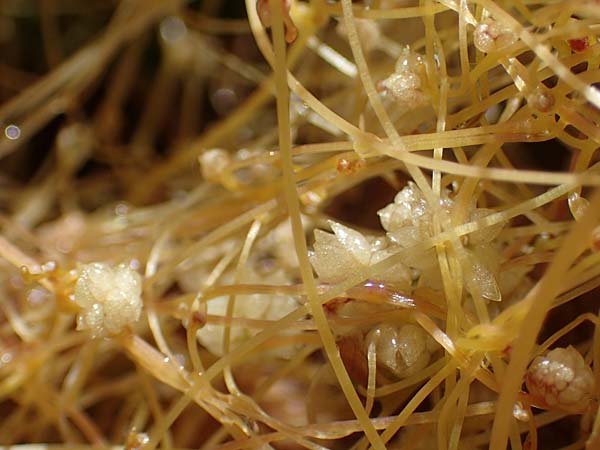
Cuscuta pedicellata besitzt 4- bis 5-zählige Blüten. Das Verbreitungsgebiet reicht von Nordafrika bis Zentralasien.
Das Spektrum der Wirtspflanzen ist nach der Literatur sehr breit, es reicht von den Fabaceae (z.B. Trifolium alexandrinum) über die Verbenaceae (Duranta erecta) bis zu verschiedenen Arten der Asteraceae.
Seltener werden auch Arten der Caryophyllaceae (Gymnocarpos), Globulariaceae (Globularia) und Convolvulaceae ( Convolvulus arvensis) genannt,
sowie sogar einzelne Arten der Amaryllidaceae ( Allium cepa), Asphodelaceae (Asphodelus) und Cyperaceae (Cyperus).
Auf Rhodos war Vicia hybrida (Fabaceae) in unmittelbarer Nähe vorhanden (siehe Fig. 1 oben rechts), ich habe aber nicht die Wurzeln ausgegraben, um die Parasitierung zu verifizieren.
Cuscuta pedicellata has 4- to 5-merous flowers. The distribution area extends from North Africa to Central Asia.
The spectrum of host plants is very broad according to literature, ranging from the Fabaceae (e.g. Trifolium alexandrinum) over Verbenaceae (Duranta erecta) to several species of the Asteraceae.
Rarely species of the Caryophyllaceae (Gymnocarpos), Globulariaceae (Globularia) and Convolvulaceae ( Convolvulus arvensis) are mentioned,
as well as even single species of the Amaryllidaceae ( Allium cepa), Asphodelaceae (Asphodelus), and Cyperaceae (Cyperus).
In Rhodes, Vicia hybrida (Fabaceae) was present in the immediate vicinity (see Fig. 1 top right), but I did not dig up the roots to verify the parasitism.
|